بسم الله الرحمن الرحيم
Overview of the book
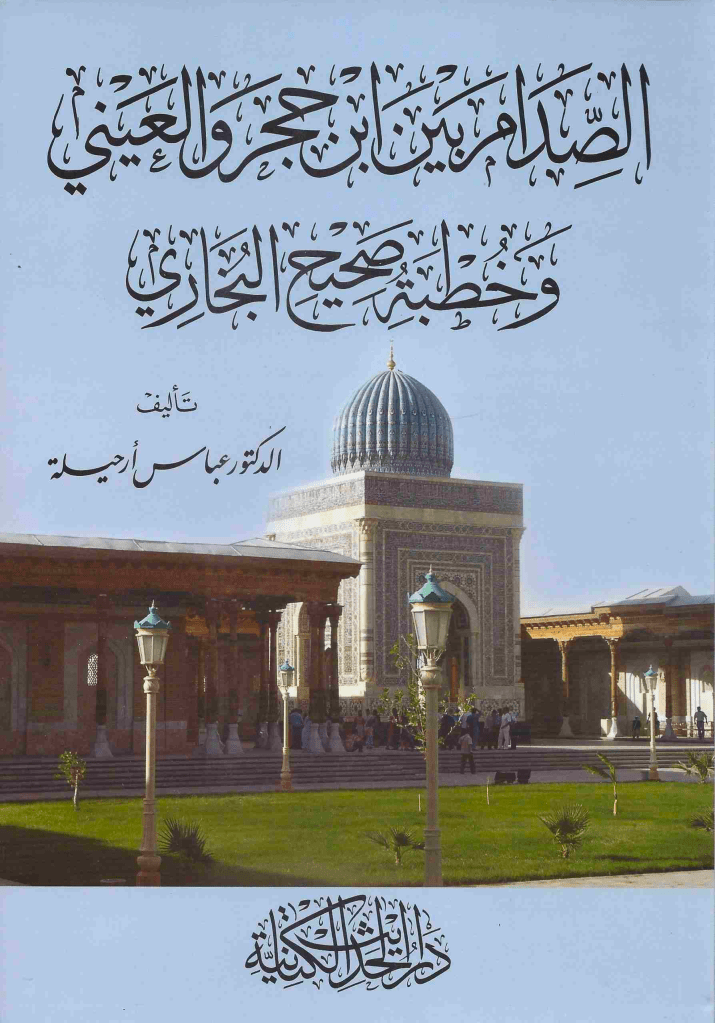
This book is titled ‘Aṣ-Ṣidām bayn Ibn Ḥajar wa ‘l-ʿAynī wa Khuṭbat Ṣaḥīḥ al-Bukhārī’ (lit. The Contentions Between Imām Ibn Ḥajar and Imām al-ʿAynī and the Introduction of Ṣaḥīḥ al-Bukhārī) by Dr. ʿAbbās Arḥīlah. It is regarding the academic rivalry that occurred between Imām Ibn Ḥajar and Imām al-ʿAynī (may Allāh have mercy on them both), as well as the difference of opinion they had regarding the khuṭbah (introduction) of Ṣaḥīḥ al-Bukhārī. It includes four main themes:
1. The contentions between both scholars
2. The consequences of the ongoing rivalry
3. The methodology of both scholars in the introduction of their commentaries
4. The position of both scholars regarding the khutbah of Ṣaḥīḥ al-Bukhārī
Imām Ibn Ḥajar and Imām al-ʿAynī
Imām Ibn Ḥajar al-ʿAsqalānī (d. 852 AH) and Imām Badr ad-Dīn al-ʿAynī (d. 855 AH) were two 9th-century scholars who wrote their individual commentaries on Ṣaḥīḥ al-Bukhārī. Imām Ibn Ḥajar wrote his renowned “Fatḥ al-Bārī” from 817 AH – 842 AH whilst Imām al-ʿAynī wrote his voluminous “ʿUmdat al-Qārī” from 820 AH – 847 AH.
A few reasons why they clashed were: they were both given the position of the chief judge, they both learned under similar teachers, they both wanted to achieve high positions close to the sulṭāns, they both wanted to write a commentary on Ṣaḥīḥ al-Bukhārī, but both adhered to different schools of fiqh, and both were highly opinionated and learned. All of this led to the beginning stages of the rivalry between them, which started off as mere competition towards the end of the year 820 AH.
When the minaret of the Muʾayyidi masjid collapsed, both scholars, who taught there, used the incident to make fun of each other through poetry. Imām Ibn Ḥajar said that the cause of the collapse was ‘ʿaynī’. Although one who hears this assumes that he intends evil-eye, he was in reality indirectly alluding to the cause being Imām ‘al-ʿAyni’. He said the following couplets:
لِجامع مولانا المُؤَيِّدِ رونق ** مَنارته بالحُسن تزهو وبالزَّيْن
تقول وقد مالتْ عليهم: تمهّلوا ** فليس على حسن أضرّ من العيني
The mosque of our master al-Muʾayyid holds a splendor,
its minaret radiates with beauty and grace.
It says whilst it had inclined on them: Be vigilant,
for nothing is more dangerous upon beauty than evil-eye (ʿaynī).
In response, Imām al-ʿAynī said that the cause for the collapse was the ‘deterioration of the ḥajar (rock)’. Of course, he was referring to Imām Ibn Ḥajar:
منارة كَعروس الحُسن إذ جَلِيَتْ ** وهدمها بقضاء الله والقَدَر
قالوا: أصيبت بِعَيْنٍ، قلتُ: ذا غلط ** ما آفة الهدم إلا خِسَّة الحَجَر
A minaret like a bride’s beauty when it becomes apparent,
and its demolition [was] by the will and decree of Allāh.
They said: It was afflicted by evil eye (ʿaynī). I say: That’s incorrect,
for the destruction was caused only by the deterioration of the rock (ḥajar).
The reason why I mentioned the poetic competition is just to indicate how sharp and eloquent they were, even if they were trying to taunt one another. If you wish to briefly read on their rivalry, objections, & commentaries, this book is a good read.
Distinguishing features of ʿUmdat al-Qārī:
- ʿUmdat al-Qārī is lengthier than Fatḥ al-Bārī, by a quarter of the book.
- There are aḥādīth that Imām al-ʿAynī has commentated more on.
- ʿUmdat al-Qārī contains beneficial taʿaqqubāt (criticism) on Imām Ibn Ḥajar.
- Imām Ibn Ḥajar first brings all the aḥādīth of the chapter, and then comments on all of them without distinction, whereas Imām al-ʿAynī separates between aḥādīth.
- In order to find the takhrīj of a ḥadīth, one can easily find it under the heading: ‘Those who have reported it besides Imām Bukhārī’. In Fatḥ al-Bārī however, one would need to read the whole commentary of the ḥadīth to find its takhrīj. Imām al-ʿAynī has also incorporated more in his takhrīj than Imām Ibn Ḥajar.
- Imām al-ʿAynī mentions if the ḥadīth is from the Mufradāt of Imām Bukhārī.
- Imām al-ʿAynī mentions the errors of commentators before him, which is quite beneficial despite his occasional excessiveness.
Distinguishing features of Fath al-Bari:
- Hudā as-Sārī: his introduction to the commentary. Imām al-ʿAynī commenced his commentary with a brief introduction that is no more than 20 pages discussing the basics related to Ṣaḥīḥ al-Bukhārī.
- His consistency in adhering to the same methodology throughout the commentary.
- Just like Imām al-ʿAynī, there are aḥādīth that Imām Ibn Ḥajar has commentated more on.
- At the end of every chapter, Imām Ibn Ḥajar mentions the marfūʿ, mawqūf, mukarrar and muʿallaq narrations, and the narrations that Imām Muslim has also reported. This is not found in al-ʿUmdah.
- He is distinguished by his honesty in the transmission of statements, his well-ordered presentation, his accuracy of expression, good summarisation, the frankness of his speech, clarity of opinion, and strength in presenting what he deems correct and refuting what appears as incorrect.
The position of both scholars regarding the khuṭbah of Ṣaḥīḥ al-Bukhārī
One of the prime differences between Ṣaḥīḥ al-Bukhārī and Ṣaḥīḥ Muslim is in that the former does not contain a traditional khuṭbah (introduction), whereas the latter does. A ‘khuṭbah’ is meant to be a prelude to the book which introduces its contents, and indicates to the author’s objectives in authoring or compiling it. Since Ṣaḥīḥ al-Bukhārī seems to be absent of a khuṭbah, the scholars’ opinions on its absence differed, and this was a contributing factor to the disagreements between Imām Ibn Ḥajar and Imām ʿAynī.
One of the primary objections made on Imām Bukhārī (raḥimahullāh) is that he did not begin his book with an appropriate introduction. Imām Ibn Ḥajar responded to this. His position was that although Imām Bukhārī did not commence with a traditional-style khuṭbah, he substituted it with the first ḥadīth that he brought under the Chapter of Revelation. Imām Ibn Ḥajar argues that Imām Bukhārī did subtly indicate to the objective of his compilation by commencing his book with the Chapter of Revelation and bringing a ḥadīth on intentions; as if he were saying, “I intend to compile the revelation of the sunnah related from the Prophet (ﷺ), in a manner that I will attain rewards based on my intentions.” Since this alone suffices in indicating to the reader the objective of the author in compiling the book, it avails Imām Bukhārī from having to write anything additional as a khuṭbah.
Another objection that is made on the author is that he did not act upon the two noble aḥādīth on the necessity of commencing all praiseworthy matters with ḥamd (praise) and shahādah (testimony). Imām Ibn Ḥajar responds to this by saying that both aḥādīth are not in accordance with the conditions of Imām Bukhārī (raḥimahullāh). Furthermore, had they been in conformity to his conditions, Imām Bukhārī may have uttered them verbally and sufficed on just writing the basmalah since it encompasses all three forms of dhikr, and it imitates the practice of the Prophet (ﷺ) when he dictated the letters to the kings of different regions.
On the other hand, Imām ʿAynī’s position was that Imām Bukhārī (raḥimahullāh) did also include a ḥamd and shahādah in his khuṭbah, however, it was omitted by some of the those who wrote their own copies and was eventually lost. Hence, Imām ʿAynī mentioned seven arguments that are presented to support the opinion that Imām Bukhārī did not have a separate khuṭbah and sufficed on bringing the first chapter and ḥadīth, and he refuted each one to support the opinion that Imām Bukhārī did have a separate khuṭbah. Among some of his brief refutations are:
- Even if the aḥādīth that encourage the basmalah, ḥamdalah, and shahādah are weak or disregarded, it does not necessarily mean that an author will leave out the taḥmīd that the Qurʾānic surahs, khuṭbahs, and letters start with.
- Even if the context of several aḥādīth that encourage these adhkār is during khuṭbahs, and the Prophet (ﷺ) is said to have mentioned this on an occasion when a bedouin delivered a khuṭbah but left out the taḥmīd, the consideration is given to to the ʿumūm al-lafẓ (general implications of the words) and not to the khuṣūṣ as-sabab (specification of the cause).
- Imām ʿAynī rejects the statement of those who say that the ḥadīth of opening with the ḥamd and shahādah is mansūkh (abrogated) because the Prophet (ﷺ) dictated the treaty of Ḥudaybiyyah without writing them, and sufficed on writing the basmalah. Imām ʿAynī responds by saying that he may have left them out to show the permissibility of doing so (bayān al-jawāz), not to indicate their abrogation.
The author of the book concluded that Imām ʿAynī was of the opinion that it is necessary for every author to use basmalah, ḥamdalah, and ṣalāt at the opening of every compilation because the Qurʾān commences with the basmalah and ḥamdalah. Imām Ibn Ḥajar responded to Imām ʿAynī’s opinion in three of his books including Fatḥ al-Bārī, Intiqāḍ al-Iʿtirāḍ, and al-Istinṣār ʿalā ‘ṭ-Ṭāʿin al-Miʿthār. Dr. ʿAbbās Arḥīlah does an excellent job in condensing these important discussions and has presented these two important topics, namely, the contentions between Imām Ibn Ḥajar and Imām ʿAynī, and the khuṭbah of Ṣaḥīḥ, in a very organized manner, making the discussions easy to comprehend and highly captivating.
May Allāh have mercy on both Imām Ibn Ḥajar and Imām ʿAynī, and accept both of their commentaries. May Allāh also accept the author’s efforts in producing this book, āmīn yā Rabb.

 Hadithiyya